
2026.04.18 In the wrong war? Spectrum | Die Presse


At the Kashtan grocery store in Jerusalem, it’s absolute chaos. Much like the only supermarket open on a Sunday in Austria, it’s teeming with people who forgot to do their shopping in time. Outside the door, a large group of Chinese construction workers are having a snack. The Russian shop is a paradise for anyone wanting to buy non-kosher products, such as ham or prawns. But the most important thing: it closes two hours later than all the other grocery shops on Friday. Shabbat begins that very evening at dusk.
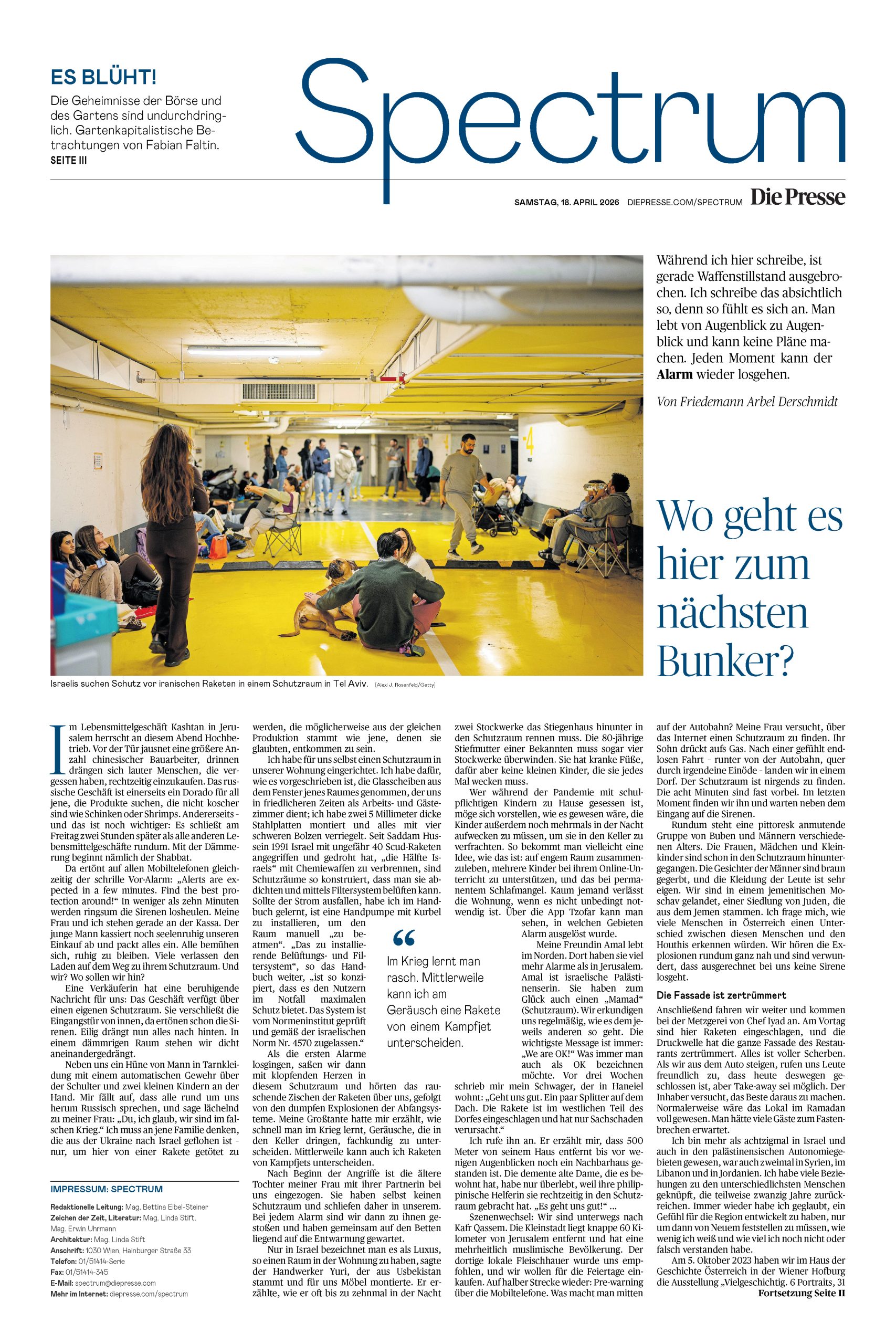
My wife and I jostle with the others in the shop. Suddenly, that shrill alarm—the one you can never get used to—sounds simultaneously on every mobile phone: “Alerts are expected in a few minutes. Find the best protection around!” A pre-alarm! In under ten minutes, the sirens will go off all around us. We’re standing at the till. Everyone’s trying to stay calm. Many are leaving the shop. A shop assistant tells us that the shop itself has a shelter. The young man at the till calmly rings up our shopping and packs everything away. The shop assistant locks the door to the shop from the inside, and then the sirens sound. Everyone now hurries to the back. In the dimly lit room, we stand huddled close together. Next to us is a giant of a man in camouflage with an automatic rifle slung over his shoulder and two small children. Suddenly it strikes me that everyone around us is speaking Russian, and I say to my wife with a smile: “You know, I think we’re in the wrong war.” I can’t help thinking of that family who fled from Ukraine to Israel, only to be killed here by a missile that may well have come from the same factory as the ones they thought they’d just escaped.
“The ventilation and filtration system to be installed is designed to offer users maximum protection in an emergency. The system has been tested by the Standards Institute and approved in accordance with Israeli Standard No. 4570…” It’s a good thing I’ve looked at the instructions for using our shelter. Even beforehand, as required, I removed the glass panes from the window leading to the room that serves as our study and guest room in more peaceful times; I slid the two 5 mm thick steel plates into place and locked them with the four heavy bolts. Ever since Saddam Hussein attacked Israel with around 40 Scud missiles in 1991 and threatened to burn ‘half of Israel’ with chemical weapons, shelters have been designed so that they can be sealed and ventilated using a filter system. I learnt from the manual that, should the power fail, a hand pump with a crank must be installed to ‘ventilate’ the room manually.
When the first alarms went off, we sat in that shelter with our hearts pounding, listening to the whistling roar of the missiles overhead, followed by the dull explosions of the interception systems. My great-aunt had told me how quickly one learns in war to expertly distinguish the sounds that penetrate the cellar. By now, I too can tell the difference between a missile and a fighter jet by sound. After the attacks began, my wife’s older daughter moved in with us, along with her partner. They don’t have a shelter of their own, so they slept in ours. Every time the alarm sounded, we would join them and lie on the bed together, waiting for the all-clear. “Only in Israel is it considered a luxury to have a room like that in your flat,” laughed Yuri, the craftsman from Uzbekistan who was assembling our furniture. He told us how he often has to run down the stairwell two floors to the shelter up to ten times a night. The 80-year-old stepmother of an acquaintance even has to climb four floors. She has bad feet but, on the other hand, no small children she has to wake up every time. Anyone who has been stuck at home with school-age children during the Covid pandemic can imagine having to wake these children up several times a night to take them down to the basement. That might give you an idea: living with sleep deprivation, in a cramped space, whilst several children are having online lessons at the same time. Hardly anyone leaves the flat unless it is absolutely necessary. You can see which areas have been put on alert via the Tzofar app. My friend Amal lives in the north. They have far more alerts there than in Jerusalem. Amal is an Israeli Palestinian. Fortunately, they also have a ‘mamad’ (shelter). We check in with each other regularly. The most important message is always: ‘We are OK!’ Whatever one might call ‘OK’. Three weeks ago, my brother-in-law, who lives in Haniel, wrote to me: “We’re fine. A few shrapnel marks on the roof. The rocket struck in the western part of the village and caused only material damage.” I ring him. He tells me that, until just a few moments ago, a neighbour’s house had stood 500 metres from his home. The elderly lady with dementia who lived there only survived because her Filipino carer got her into the shelter in time. “We’re fine!”…
Change of scene: We’re on our way to Kafr Qassem. The small town is just under 60 km from Jerusalem and has a predominantly Muslim population. The local butcher there was recommended to us and we want to do some shopping for the holidays. Halfway there again: a pre-warning on our mobile phones. What do you do in the middle of the motorway? My wife tries to find a shelter online. Her son puts his foot down. After what feels like an endless drive – off the motorway, across some wasteland – we end up in a village. The shelter is nowhere to be found. The eight minutes are almost up. At the last minute we find it and wait by the entrance for the sirens. All around stands a picturesque-looking group of people. Boys and men of various ages; the women, girls and small children have gone down into the shelter. The men’s faces are tanned and the people’s clothing is very distinctive. We have ended up in a Yemeni moshav, a settlement of Jews who originate from Yemen. I wonder how many people in Austria would recognise a difference between these people and the Houthis one occasionally sees on television – and no, settlement here does not mean the West Bank. We hear the explosions all around us very close by and are surprised that, of all places, no siren goes off here. We reach Chef Iyad’s butcher’s shop. Rockets struck here the day before and the shockwave shattered the entire façade of the restaurant. Everything is covered in shards. As we get out of the car, people call out to us in a friendly manner that it’s closed today because of this – but takeaway is available. The owner is still trying to make the best of it. Normally, the place would have been full during Ramadan. They would have expected many guests to break their fast.
I have been to Israel and the Palestinian territories more than 80 times, and have also been to Syria, Lebanon and Jordan twice. I have forged many relationships with a wide variety of people, some of which go back 20 years. Time and again, I thought I had gained a feel for the region, only to realise anew how little I know and how much I have yet to understand or have misunderstood.
On 5 October 2023, we opened the exhibition “Multilayered: 6 Portraits, 32 Conversations, 6 Languages” at the Haus der Geschichte Österreich in the Vienna Hofburg. In the exhibition, we have attempted to illustrate the enormous complexity of overlapping life stories using specific people in Vienna. However, the diversity and density here in the region is many times greater. My wife came to Vienna especially for the opening. Her return flight was due to be two days later: on 7 October!
We sat at the breakfast table in shock. My wife and my son-in-law, who is from Syria and lives with me, were both nervously smoking cigarettes early in the morning – neither of them ever does that… Post-traumatic stress.
Three days later, we flew to Jerusalem. That was only possible because my wife is a doctor. At Vienna Airport, there were three times as many people as could fit on the plane. They tried to persuade people to give up their seats to young soldiers. Never in my life had I been so afraid. We were flying into the unknown.
The next morning in Jerusalem, everything was deathly quiet. Every sound on the street made me flinch. East Jerusalem is barely a 20-minute walk from where we were staying. I had the feeling that, there as well as here, everyone was terrified that their neighbours might attack them at any moment, armed. That atmosphere is unforgettable to me. And everywhere it smelled of marijuana. It’s prescribed medically for PTSD. You could literally smell the collective trauma.
Only one tiny café was open. It’s run by Yonni. Yonni’s Jewish family comes from Yemen and he’s very proud of that. He speaks not only the local Palestinian Arabic, but also the Yemeni dialect. I sit down with Yonni because I can’t stand it at home. Then Yael (name changed) comes over and asks if she can sit with me. I’ve been friends with her and her husband for many years, but now I’m getting to know her all over again. We’re both full of fear. She describes how various traumas have layered themselves over her life. Suddenly, she’s completely open. Her first childhood memory is fear. Fear of having to grow up without a dad. He’d been critically wounded in the Yom Kippur War. Then, as a young woman, she is sitting in a car on the Tel Aviv ring road with her one-year-old child on her lap. The siren goes off – I know now how that feels. No chance to protect yourself. A SCUD missile strikes just a few metres in front of the car. In the third story, she is standing at Dizengoff bus station in Tel Aviv early in the morning, waiting for the bus to a job interview. A woman strikes up a conversation with her and suggests they go to her office. She is also looking for someone like her. No sooner have they left the station than the bus explodes. Twenty-two people were killed instantly. Since then, many friends and acquaintances have told me stories like this. Trauma is everywhere here. It respects neither religious nor ethnic boundaries, and I admire how the majority of people here cope with it. My wife works as a surgeon in the hospital. There is hardly a better place here to study the complexity of society. More than a third of the staff are Arab. They are evenly distributed from nursing staff to doctors and surgeons. Women rock their children to sleep side by side, some dressed in traditional Muslim attire, others in Jewish religious garb. You hear Hebrew, Arabic, Russian and English… Indeed, no one here can live without this pragmatic coexistence. The majority of security staff in Jerusalem are Arab! They monitor the entrances to supermarkets, shopping centres and hospitals to prevent terrorist attacks. No one would claim that everyone here gets on well, but they live together every day. As I write this, a ceasefire has just broken out. I’m writing it like this on purpose, because that’s how it feels. You live from moment to moment and can’t make any plans. The alarm could go off again at any moment. For long stretches, war actually feels peaceful. The sun is shining and the birds are singing, until it all starts again. This has a devastating effect on the psyche. The closest way to describe it would be as a colossal collective case of ADHD. You can’t think clearly, you’re extremely nervous and constantly distracted. Here, almost every task takes me four times longer than it would under normal circumstances in Vienna. My wife, whose mother survived the Holocaust, told me later that the tall man who was in the shelter with his children in the Russian shop had asked for ‘a hiding place’ in such a way when he entered the shop as a defenceless child would have done during the Holocaust.


