
2026.08.22 You don’t buy green bananas in Israel | Spectrum | Die Presse Copy

this is an automatic translation:
You don’t buy green bananas in Israel
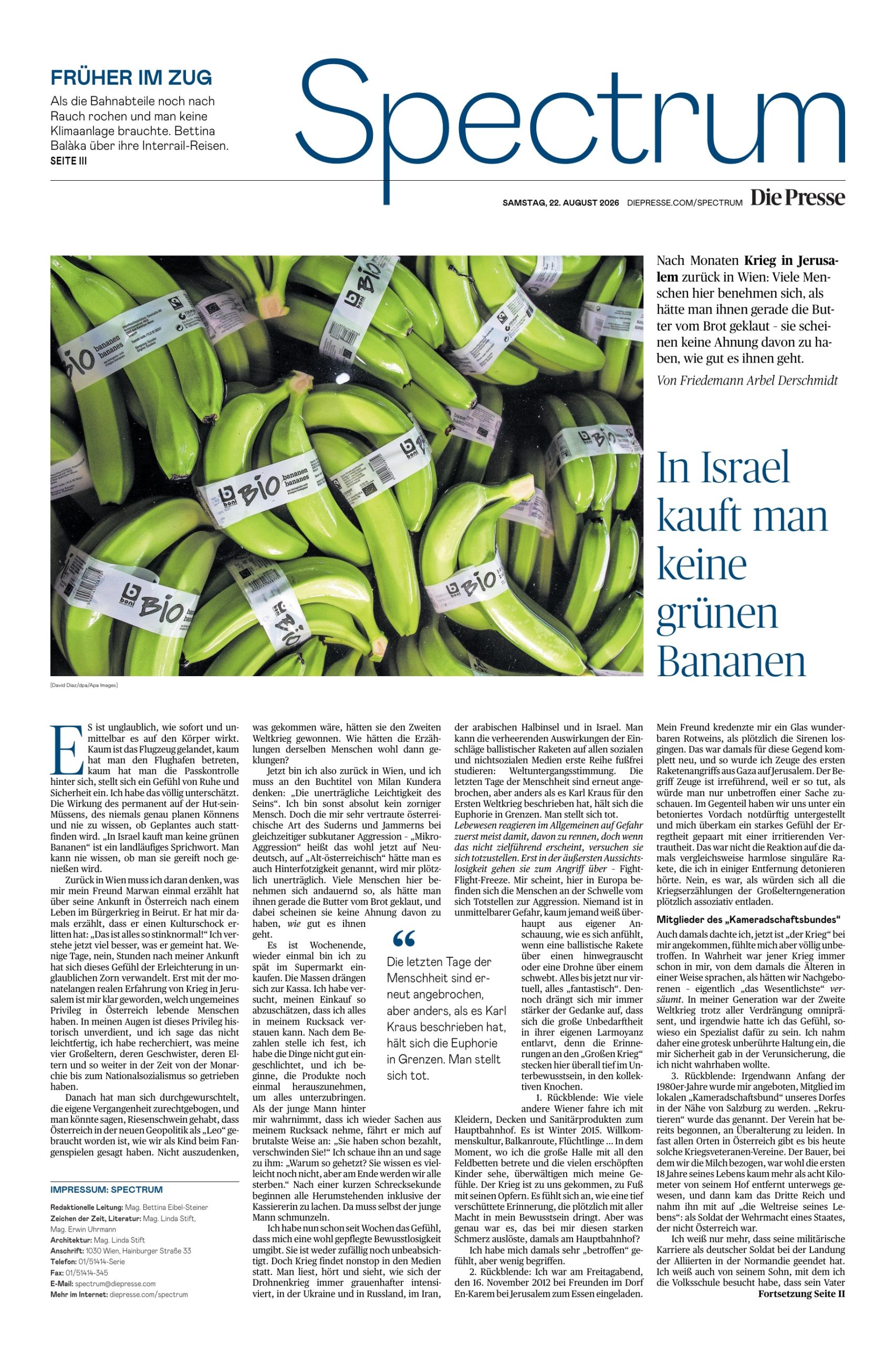
It is incredible how immediately and directly it affects the body. As soon as the plane has landed, as soon as you have entered the airport, as soon as you have passed through passport control, a feeling of calm and security sets in. I completely underestimated this. I underestimated the effect of having to be constantly on guard, of having to be constantly aware that an alarm could go off at any moment, of never being able to plan precisely and never knowing whether something you have planned will actually happen. “In Israel, you don’t buy green bananas” is a common saying. You can never know whether you will still be around to enjoy them once they have ripened.
Back in Vienna, I have to think of what my friend Marwan once told me about his arrival in Austria after a life spent amid the civil war in Beirut. He told me at the time that he had experienced a culture shock in the face of the feeling of peace: “that everything is so fucking normal!” I understand much better now what he meant. A few days—no, hours—after my arrival, this feeling of relief transformed into incredible anger. Only after months of real-life experience elsewhere, carried with me in my luggage, did I realize what an enormous privilege people living in Austria have. In my eyes, this privilege is historically entirely undeserved, and I do not say that lightly. I have done my homework when it comes to researching what my four grandparents, their siblings, their parents, and so on were up to during the period from the monarchy through National Socialism.
After that, people muddled through, bent their own history into a more convenient shape, and one might say they were incredibly lucky that Austria was needed in the new geopolitical order as a “Leo”—as we used to say as children when playing tag. It is impossible to imagine what would have happened had they won the Second World War. What would the stories told by exactly the same people have sounded like then? If you look closely, there is absolutely nothing to whitewash.
So now I am back in Vienna, and I have to think of the title of Milan Kundera’s *The Unbearable Lightness of Being*. Yes, that is the source of my sudden anger. I am normally not an angry person at all. Yet shortly after returning from Israel, from the war, I discovered a great deal of anger in myself. The very familiar Austrian habit of complaining and moaning while simultaneously harboring a kind of subliminal aggression—“microaggression,” I suppose we call it in modern parlance; in old Austrian German, one might simply have called it *Hinterfotzigkeit*—sneakiness or spitefulness—has suddenly become unbearable to me. Many people here constantly behave as though someone has just stolen the butter from their bread, while at the same time they seem to have no idea HOW good they have it.
It is the weekend, and once again I am doing my supermarket shopping too late. The crowds are pressing toward the checkout. I have tried to estimate my shopping so that I can fit everything into my backpack. After paying, I realize that I have packed things badly and start taking the products out again so I can fit everything in. The moment the young man behind me notices that I am taking things out of my backpack again, he angrily snaps at me in the most brutal way: “You’ve already paid, now get out of the way!” I look at him and say: “Why are you in such a hurry? You may not know it yet, but in the end we’re all going to die.” After a brief moment of stunned silence, everyone standing around, including the cashier, starts laughing. Even the young man has to smile.
For weeks now I have had the feeling that I am surrounded by a carefully cultivated state of obliviousness. It is neither accidental nor unintended. And yet war is happening nonstop in the media. You read, hear and see how the drone war is intensifying in ever more horrific ways in Ukraine and Russia, in Iran, on the Arabian Peninsula and in Israel. You can study the devastating effects of ballistic missile strikes from the front row on all kinds of social and non-social (?!?) media: an end-of-the-world atmosphere. The last days of humanity have dawned once again, but unlike the way Karl Kraus described the First World War, there is little euphoria. People play dead. Living creatures generally respond to danger first by running away, but if that does not seem to work, they try to play dead. Only in the most desperate circumstances do they go on the attack—fight, flight, freeze. And it seems to me that here in Europe, people are on the threshold between playing dead and becoming aggressive. No one is in immediate danger; hardly anyone knows from personal experience what it feels like when a ballistic missile tears through the sky above you or a drone hovers overhead. So far, everything is virtual, everything “fantastical.” Nevertheless, I increasingly find myself thinking that this great obliviousness is exposing itself through its own self-pity, because memories of the great war run deep in the collective unconscious here.
**1. Flashback:** Like many other Viennese, I drive to the central railway station with clothes, blankets and sanitary products. It is winter 2015. Welcome culture, the Balkan route, refugees… The moment I enter the huge hall with all the camp beds and see the many exhausted children, I am overwhelmed by incredibly powerful emotions. I never cry, but now I cry, and I think to myself: *Now the war has come to us, on foot, with its victims.* It feels like a deeply buried memory that has suddenly forced its way into my consciousness with tremendous force. But what exactly was it that triggered such intense pain in me at the central station back then?
At the time I felt deeply “affected,” but understood very little.
**2. Flashback:** On Friday evening, November 16, 2012, I was invited to dinner by friends in the village of Ein Karem near Jerusalem. My friend poured me a glass of wonderful red wine when suddenly the sirens went off. This was completely new for that area at the time, and so I witnessed the first-ever rocket attack from Gaza on Jerusalem. The term “witness” is misleading because it suggests that one merely watches something without being affected by it. On the contrary, we took makeshift shelter beneath a concrete awning, and I was overcome by a powerful sense of heightened excitement coupled with an unsettling familiarity. This was not a reaction to the comparatively harmless single rocket that I heard exploding some distance away. No, it was as if all the stories of war told by my grandparents’ generation were suddenly being released through a chain of associations. Even then I thought: now “the war” has arrived where I am, while in concrete terms I felt completely untouched by it.
In truth, that war had always been inside me—the war that older people used to talk about as though we, those born afterward, had somehow missed “the most essential thing.” In my generation, the Second World War was omnipresent despite all the repression and denial, and somehow I felt that I was a specialist on the subject anyway. I therefore adopted a grotesquely detached attitude that gave me a sense of security amid an insecurity I did not want to acknowledge.
**3. Flashback:** Sometime in the early 1980s, I was invited to become a member of the local *Kameradschaftsbund* in our village near Salzburg. They called it “recruiting.” The association had already begun to suffer from an aging membership. To this day, there are such war veterans’ associations in almost every town in Austria.
The farmer from whom we got our milk had probably spent almost the first 18 years of his life traveling no more than eight kilometers from his farm. Then came the Third Reich and took him on “the journey of his lifetime” as a soldier in the Wehrmacht of a state that was not Austria. All I remember is that his military career as a German soldier ended with the Allied landings in Normandy. I also know from his son, who attended primary school with me, that his father could no longer sleep through the night and would often wake up screaming.
How many of the millions of defeated, completely broken soldiers brought home severe post-traumatic stress disorders after the collapse of the Nazi empire? Who could they have talked to? Those who had stayed at home were overwhelmed and, ideally, wanted to know nothing about it. So in our village, as in so many other communities, all those who had experienced and done similar things came together. Who else could they have talked to? Were not most of their contemporaries themselves compromised in one way or another? What had everything they had done, suffered and perpetrated over the previous five years actually been for?
It was a desperate attempt to create some kind of self-help group. Over a great deal of beer, they talked to one another in an effort to find relief. But what answers could possibly have provided that relief? And presumably, the “best answers” for justifying their own actions often came from the arsenal of the former Nazi propaganda machine, so they talked a great deal about heroism and defending the homeland. I would not be surprised if quite a few of the more politically naïve were politicized in precisely these milieus after the war. A kind of “post-war second-hand ideological indoctrination.” How much war has been preserved here and passed down from generation to generation to this very day?
**Scene change:** We are standing beside the open grave of one of my uncles in a village in the Tullnerfeld. For my Israeli wife, it is her first Catholic funeral ever, so I whisper an explanation of what is happening. We have already been through the funeral Mass, during which we learned that my uncle was a highly respected member of the local volunteer fire brigade. His firefighter’s helmet has even been placed on his coffin. There are an extraordinary number of people present—*a schöne Leich*, as the saying goes, meaning an impressive or well-attended funeral.
The fire brigade’s brass band stands in formation, wearing brown uniforms. The fire chief addresses the deceased directly in his eulogy and ends with the words: “Now, for the last time, our siren will call you to duty!” I immediately take my wife’s hand and warn her. From experience, I know how deeply frightening it can be when a siren unexpectedly goes off nearby. The coffin is then lowered into the grave, helmet and all, while the brass band fervently plays the old Wehrmacht hit *Ich hatt einen Kameraden* (“I Had a Comrade”).
It is 2026!
I grew up in the countryside, and I have found that it is extremely difficult, if not impossible, to convey to people socialized in Vienna the deeper social significance of these structures. In Vienna, too, you stumble across unresolved remnants of the Holocaust and the war at every turn, but atmospherically I experience an almost insurmountable difference between the city and the countryside. The more often I return to Austria from the Middle East, the more strongly I experience an even more insurmountable difference. Increasingly, I find myself feeling misunderstood by good friends in Austria whom I have known for many years, because their “being affected” reminds me of my own back then. Their “security” makes me angry.
Friends in Vienna who, because of their own histories, understand the complexity, fragility and vulnerability that accompany or underlie violent conflicts are becoming increasingly important to me. It is irrelevant which side they are assigned to. The people I spend time with are not interested in war—they know it too well, because they have experienced its consequences themselves.


